Showing posts with label education. Show all posts

Tuesday, May 29, 2007

Literacy and equality

The other day another postdoc in the lab was having a conversation with one of the grad students and they were both speaking in mandarin (I am assuming). Normally it's easier for me to tune out conversations that aren't in a language that I understand. However, this particular conversation was punctuated with non-mandarin words like "analysis of variance" and "posterior probability" (this particular postdoc is the lab's resident statistician, can you tell?). So I started unintentionally tuning them in every time I heard a word or phrase that was distinctly not mandarin.

After the student left I turned to Dr. Stats and told him that I thought it was funny how his conversation was sprinkled with so many english words (I really did find it amusing). He told me that most of the time jargon like that is just easier to say in english because you never know if the other person knows the correct chinese word for what you are talking about.

Then we talked about how new words are invented in one language, and sometimes adopted in all languages, or translated into language specific jargon. I always think of how the french word for "shampoo" is "shampooing" - just because as a kid that always made me laugh... the "pooing" part anyway. But for new fields of research (ie. New-ology) Dr. Stats told me that instead of just adopting the english word, the chinese generally construct their own proper translation since they would have appropriate words for whatever the "new" part was and the "ology" as well.

From there he demonstrated how the written characters of the chinese are useful for such pairings. And I told him how I had once taken a Japanese class and learned a few chinese characters from that class, but how I found them very complex and difficult to remember how to write.

Then I got a really interesting history lesson.

Apparently the chinese government was paying attention to how difficult it was to be literate in chinese, so in the 1950's they decided to revamp many of the most commonly used characters to simplify them. I won't go into too many details (we probably talked and read wikipedia for an hour during my history lesson), but the literacy in China before the simplification of characters was very low. We're talking only the very rich, and those in larger cities. But China has a huge population, and many live in rural areas where perhaps only one person in a village knew even a handful of written characters. Now the literacy rate is above 90%, and even higher among the younger people of China. They also introduced laws requiring children up to a certain age to attend school, so I'm sure that has helped and is probably why the younger generation have an even higher literacy rate than the general population in China.

But what kept striking me as amazing was the fact that one of the worlds most populous countries was able to change their written language - and do so successfully! I can only imagine the riots and complaints that would take place in north america (or europe for that matter) if any of the governments decided to make people re-learn their written language!! It would never happen! But Dr. Stats assured me that because the literacy rate was so low when the chinese government did this, most people were happy to have an easier system to learn - and also, that no one dared argue too loudly against what the government told them to do.

Part of me is just so proud of that endeavour - it seems to have been very successful, despite how huge of a change it was (changing what side of the road a country drives on seems teeny in comparison). I'm still amazed that they pulled it off.

One last thing Dr. Stats told me about the Chinese government - they had a slogan that went something like:

We don't worry about poverty, we worry about inequality.

I can't say which I would worry about more, but still the socialist in me applauds.

Monday, May 21, 2007

Certainty

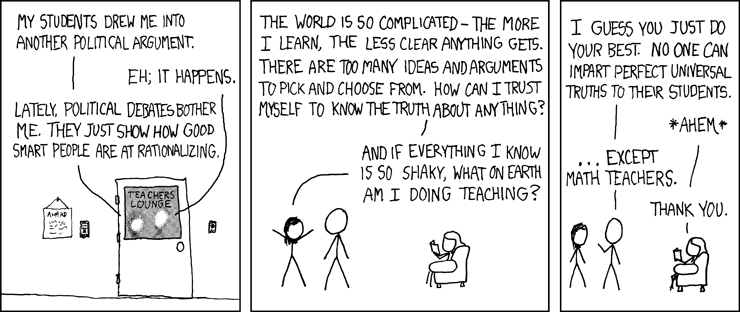
Maybe it was the line about smart people being good at rationalizing (and how that can lead to many hours of chasing our own tails), or maybe it is my training in mathematics - but this lovely comic courtesy of the very talented Randall Munroe at xkcd made me smile.


I think it may also be irony of how so many of us feel in the pursuit of knowledge and truth.

But it's still not enough to make me abandon science just yet.

Monday, May 14, 2007

Priorities

In evaluating my career goals (this is supposed to be one of the first steps if you're searching for that elusive dream job), I think I have discovered a few things about myself that I hadn't acknowledged previously.

First, money does matter. I don't need incredible amounts of money (but it wouldn't hurt!) to feel satisfied, but there is a real connection in my mind between pay and recognition for doing a good job or something of value. If I were to earn more than a professor, I think I could more easily get rid of the notion that leaving academia is a "step down." However, the more I read about careers outside the ivory tower, the more that notion is evaporating on its own.

As I continue my day to day activities as a postdoc here at fantastic U, I can recognize many things I would miss about leaving academia (virtually no dress code, very flexible hours, so much opportunity for leisure activities through campus groups/clubs/teams, a sense of community, some notion that I have the time and encouragement to continue learning new topics and skills, and travelling the world to attend conferences). But some of these things are not guaranteed at all institutions. And some of these could possibly be found outside of academia. But because my experience is so limited (and confined to only two very great universities), it is hard to know what aspects of an academic career are rigidly imposed everywhere, and which ones are variable.

If I were to pursue a tenure track faculty position, in the country where I am from (and where I will return after this postdoc) virtually all universities appear to have a 45:45:10 ratio for research, teaching and service requirements. Although research tends to be emphasized more than teaching. But as much as I would like to be a role model and mentor for students, I really have no passion for teaching. I have been told that I am a good teacher - but I was also good in math, and I didn't pursue that beyond undergrad either. Being good at something is not always enough.

I feel that if I really dedicated myself to teaching I could do a good job. But I do not think that being a tenure track faculty member would allow me the time I would need to prepare the way I would want to for teaching. So either my research would suffer, or I would never feel adequately prepared for teaching. From my experience most professors chose research over teaching, maybe not even deliberately, and the students end up with mediocre classes - that is just not good enough! They are paying a lot of money for their education, they at least deserve passionate teachers! But far too often in academia teaching is undervalued, and research seems to be the only universal measure of success. This just seems so wrong to me.

I really enjoy being a mentor - in fact I am passionate about helping people. I enjoy the one-on-one time I have spent with undergrads and fellow grad students. But it seems that to get such a balance (research, mentoring, and little to no-classroom teaching) you have to leave the ivory tower of my country.

A research career in a national lab, rather than at a university might resolve this issue for me. But I still have a lot to investigate about what the day to day work is like. And I still feel like I'm abandonning all my potential future students if I turn away from teaching. This academic career has become so ingrained that it makes me feel guilty about imaginary students from the future!

If I were at my old university, this would be the perfect time to head over to the on campus pub for a drink on the patio. Instead I will sit at my desk and read a review paper. Because that's what we do at fantastic U.

Tuesday, May 1, 2007

Power-houses and small talk

I just finished running through my talk for the conference this weekend. Only two slides won't make the cut (due to time constraints), but I will tack them on to the end, after the acknowledgments in case someone asks a question specifically about the subject of those slides. Otherwise I think the timing is fine - though I feel a little rushed. I will probably put the time into actually semi-scripting the talk. I figure conferences, defences, and job talks are worth the added effort. When else do I have a captive audience for an extended period of time? I might as well do my best to make it worth their time too! I don't imagine I'd be able to put this much effort into daily lectures, but that is a different arena - facilitating the transfer and uptake of knowledge can be done in other ways. Next year I might even take some courses on teaching science - but I'm putting that off until I figure out what my next project will be.

I've been reading an awful lot of text books lately. I find that when I read about topics I have previously studied, but mostly forgotten, I gain a better, more firm understanding of the subject. Often times the terminology sticks, but the solid understanding fades quickly after the final exam. I worry that I will soon lose all but my mathematical vocabulary, and much of my other science knowledge as well! But it is difficult to find the time to reaquaint oneself with undergraduate subjects - and especially daunting when you have no professor to lecture for you, and instead only large texts books to sift through for the passages that will be most useful. What I find even more frustrating is that because I have no exam to study for, I don't know what information is worth retaining, and what can be glossed over. In an ideal world where I could retain everything I wouldn't gloss over anything - but I often feel that my brain is reaching critical capacity as is, and I really don't want to forget my phone number or where I live just so that I can remember all the components needed by mitochondria, for instance, to perform their various functions. It has been far too long since I've studied these things. I need a system.

I started writing down random thoughts, questions and ideas for research projects. It has been very helpful alleviating my worries of forgetting thoughts that might be terribly useful in the future. But those scattered scraps of paper need a home and some organization of their own. I think I need a "thoughts" book - I already have a "lab notebook" so that months from now I can figure out what the heck I was doing today. Hopefully the "thoughts" book can somehow help me write down things I've learned form my readings as well - despite the lack of a final exam, I'd still like to retain what I learn somewhere! I just can't believe it has taken me this long to get organized.

Anyway, I've been reading a lot of textbooks. I am trying to re-learn cell biology (actually, I am trying to learn it for the first time, since the course I took in undergrad was "problem based learning" and very little learning actually took place). How can I study anything in biology, even if it is only tangental to my work, without a thorough understanding of how the basic units work?